
CEO’s Report: What does it take to attract a data center?
December 8, 2025*Updated February 2026
Heartland Energy launched the Interruptible Load Program to help customers attract data centers while ensuring continued availability of reliable and cost-effective energy.
The program was carefully crafted to eliminate risk to the city while allowing it to benefit from an economic opportunity without putting extra strain on the grid.
Public power communities offer a variety of unique advantages that make them attractive to data centers. Because data centers use large amounts of electricity, the interruptible, affordable rate is a significant draw.
However, electricity price is only one of several key factors data centers consider when choosing a location.
What is a data center?
Data centers come in all shapes and sizes. Some are large, used for storing and processing vast amounts of digital information. These provide the backbone for digital services such as streaming movies to online shopping to cloud-based business tools.
Large data centers need continuous operations to ensure information is accessible around the clock.
Heartland’s Interruptible Load Program is designed primarily for smaller, flexible data centers that agree to interruptible electric service, or any center that can adjust power usage during peak demand times.
An interruptible electric rate gives large electricity users a lower-cost option in exchange for agreeing that the utility or market can temporarily reduce their power during times of high demand.
This predominantly targets cryptocurrency centers, but any center capable of meeting the requirements is eligible.
The program is structured to provide economic gains with no risk to the city and no added strain on the grid. Essentially, the center would have to meet requirements and be able to interrupt service if the market or city called on it to do so.
Where can data centers locate?
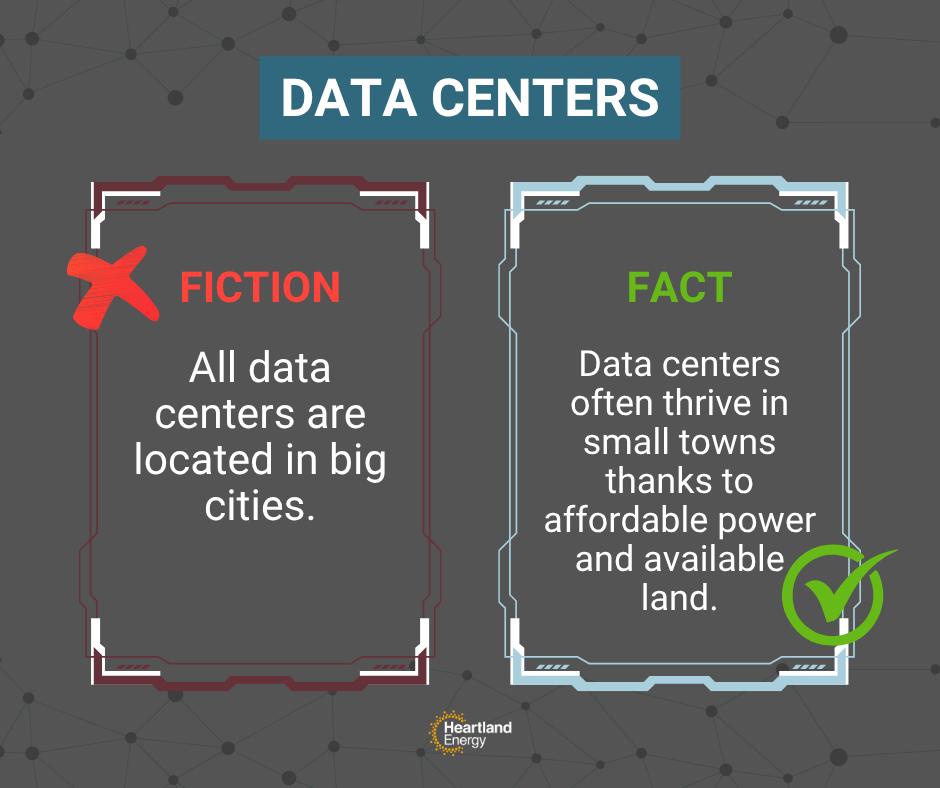
Mostly, data centers are looking for affordable electricity, reliable infrastructure and favorable local conditions.
However, the cost of power and availability are typically the biggest drivers. Because they operate continuously, they use a lot of power, and therefore are looking for low, stable rates. They also need access to a robust transmission system and reliable power supply.
Because they use a lot of electricity, the community they locate in must have the capacity to accommodate them.
Data centers examine how much electricity the city currently serves, how much of the system’s infrastructure (substations, transmission lines, transformers) is already committed, and how much extra “headroom” is available. A system with limited spare capacity might require costly upgrades or negotiations with the utility, which can make a location less attractive.
The ability to utilize existing assets to bring the loads online help reduce upfront costs.
Land availability is also a driver. Data centers with 10 MW of load typically occupy two acres of land. Build-ready sites with room for growth are particularly attractive.
Ideal locations will also sit close to essential infrastructure such as substations and transmission lines.
Impact on rates
A misconception about data centers is they drive up electric rates. Public power communities also have an advantage in this area.
Because they use a significant amount of electricity, new infrastructure is sometimes required to serve them. Heartland’s Interruptible Load Program stipulates that any needed infrastructure is paid for by the center.
If the utility already has enough capacity, a data center’s steady, around-the-clock power use can contribute to rate stability by generating additional revenue without ever increasing costs for existing customers.
In other words: data centers don’t automatically raise electricity prices — especially in public power communities.
With thoughtful planning, transparent decision-making, and cost-of-service principles guiding every contract, public power utilities can welcome economic development while keeping power affordable for the people they serve.